

Power to the People
As airlines plan their in-seat power strategies for the coming decade, they must navigate an increasingly complex landscape of passenger devices and evolving technological demands.
Karen Rogers, Marketing & Admin Manager at IFPL, tells us more:
Airline In-Seat Power: A Scalable Approach
Whilst smartphones remain the primary device for an almost infinite range of entertainment and communication activities on board, travellers are also bringing a growing array of additional power-hungry devices. Tablets for in-flight entertainment, laptops to support business professionals, and a growing prevalence of handheld gaming devices further expands the range of power requirements airlines must accommodate.
This increasing demand presents a critical challenge: designing an in-seat power system that balances efficiency, weight, cost, and scalability. What is needed is a well-engineered solution that prevents excessive strain on an aircraft’s power infrastructure, avoids any unnecessary weight penalties, and ensures seamless passenger satisfaction.
By adopting a strategic approach, airlines can future-proof their cabins, optimising power distribution without compromising on operational efficiency.
Another factor to consider is passenger expectation. If they board with their tablet at 42% battery, use it throughout the flight, and arrives with the same charge level, their perception of the power system will be that it is effective.
To maintain power levels typically:
- Smartphones such as iPhone15, Samsung Galaxy S24, or a Google Pixel 8 need 3-6W
- Tablets such as an iPad Air, Samsung Galaxy Tab, or Amazon Fire HD need 6-12W
- Ultrabooks and Laptops such as the MacBook Air, Dell XPS 13, or Lenovo ThinkPad X1 Carbon need 30-45W
- Gaming Laptops such as the MacBook Pro 16″, Razer Blade 15, or Dell G5 need 60-100W
- Handheld gaming devices with their high-resolution graphics such as an MSI Claw 8 AI+, Lenovo Legion Go, or Nintendo Switch (OLED) need 20-60W
These values reflect the power required to sustain battery levels during typical usage, rather than to increase charge from a low battery state.
For Example, Power Consumption by Device Activity:
| Activity | Phone | Tablet | Laptop | Handheld |
|---|---|---|---|---|
|
Idle, Screen on, Wi-Fi off |
2 – 4W |
2 – 6W |
10 – 20W |
6 – 15W |
|
Web Browsing/Messaging |
3 – 5W |
5 – 10W |
20 – 30W |
|
|
Streaming video/audio |
4 – 6W |
8 – 12W |
30 – 50W |
|
|
Gaming |
5 – 9W |
10 – 15W |
60 – 100W |
20 – 60W |
These are broad ranges driven by many factors, i.e. screen brightness, connectivity, and content.
"Airlines need to understand their passenger demographics and onboard activities to determine the appropriate power system requirements".
If internet connectivity is not available on board, some devices will have limited functionality, which will lead to a reduced overall power demand.
What is USB-PD?
USB Power Delivery (USB-PD) is a fast-charging protocol used over USB Type-C connections that enables higher power transfer compared to traditional USB Type A related charging standards.
It is commonly used for charging smartphones, tablets, laptops, monitors, and other high-power devices.
The USB-PD protocol follows a structured communication and negotiation process.
When a device (e.g., a tablet) is plugged into a USB-PD charger, it communicates with the charger. The charger sends a message listing all supported available voltage and current options (e.g., 5V/3A, 9V/3A, 20V/3A etc). The device evaluates its power needs based on its battery state, temperature, and input limits and then sends a Request Message choosing the most appropriate voltage and current.
In practical terms this means that devices can charge with a variety of different available power levels. A tablet may be sold with a 30W charger that charges from zero to full battery in 2 hours, but the same tablet will maintain battery level or happily charge with a lower power charger, it will just take longer.
How Many Passengers Use Each Device Type?

This varies greatly depending on the airline type, target passengers, and routes. For example:
- For laptop users, full-service carriers targeting first and business class passengers typically see higher demand for 60W power. This demand decreases with hybrid or mid-tier airlines and further drops with low-cost carriers (LCCs) and ultra-LCCs, where the seat pitch often limits laptop use to exit rows or higher-priced seats with extra legroom.
- Flight duration and the availability of onboard WiFi, as well as whether the aircraft has external internet connectivity, significantly influence power demand.
- Whether the onboard WiFi is complimentary or comes at an additional cost also affects power usage.
Typically, we find:
- Phones are nearly universal across all cabin classes, meaning every seat should have a minimum USB outlet.
- Tablets are very common, especially in economy and premium economy.
- Laptops are most prevalent in business and first class,
- Flights focused on families with children/teenagers will have a higher number of gaming consoles.
Designing a Scalable In-Seat Power System
A future-proof airline power system should provide:
Basic power for all passengers – sufficient for phones and tablets.
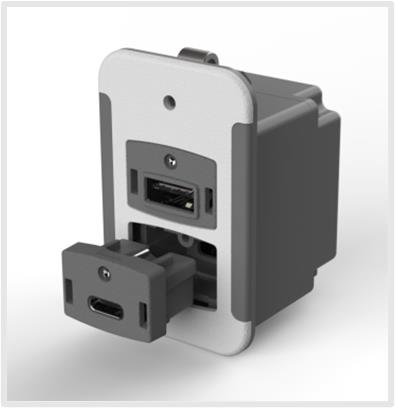
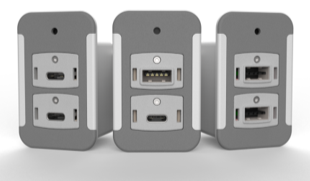
Recognising that many passengers still carry USB-A cables and will do so for many years, means that this is best delivered by a combination of USB A&C outlets either on a 1 per seat, or a 2 per triple (n-1) basis.
The absolute minimum power consideration should be 10W for USB-A, and 15W for USB-C.
Modular outlets that can be upgraded from USB-A to USB-C as the adoption of the latter expands.
Selective availability of higher-power USB-C either by cabin class, or by dynamic smart power management throughout the aircraft.
Modular upgrades to increase capacity as demand grows, meaning airlines can increase power levels over time reducing weight and cost until needed.
Smart Power Management: Avoiding Overload minimising weight and cost
To minimise weight and cost and prevent excessive power draw, airlines have the ability to implement dynamic power allocation:
- Power-sharing technology – the system should constantly monitor the total demand for power and redistribute available power dynamically.
- The system should be flexible and allow for example, seat-based prioritisation, business, and first-class seats can be assigned ‘guaranteed 60W’, while economy seats can share what is remaining.
- Adopting the Industry Standard USB-PD protocol delivers standard voltage steps of 5, 9, 15 and 20V with a fixed 3A enable the outlets to deliver power in 15, 27, 45 and 60W. (USB-A outlets follow the BC1.2 standard).
Conclusion
As the demand for in-seat power grows, airlines must strategically plan their power systems to meet both current and future passenger needs.
A thoughtful balance of efficiency, scalability, and smart power management will not only ensure a seamless experience for passengers but also contribute to the long-term sustainability of aircraft operations. By implementing modular systems with dynamic power distribution, airlines can remain adaptable to evolving technologies, while keeping costs and weight to a minimum.
As we look forward to the next decade, it’s clear that the future of in-seat power will be defined by systems that evolve with passenger expectations, supporting a connected, comfortable, and efficient flying experience.
First published in Aviation Business News in July 2025